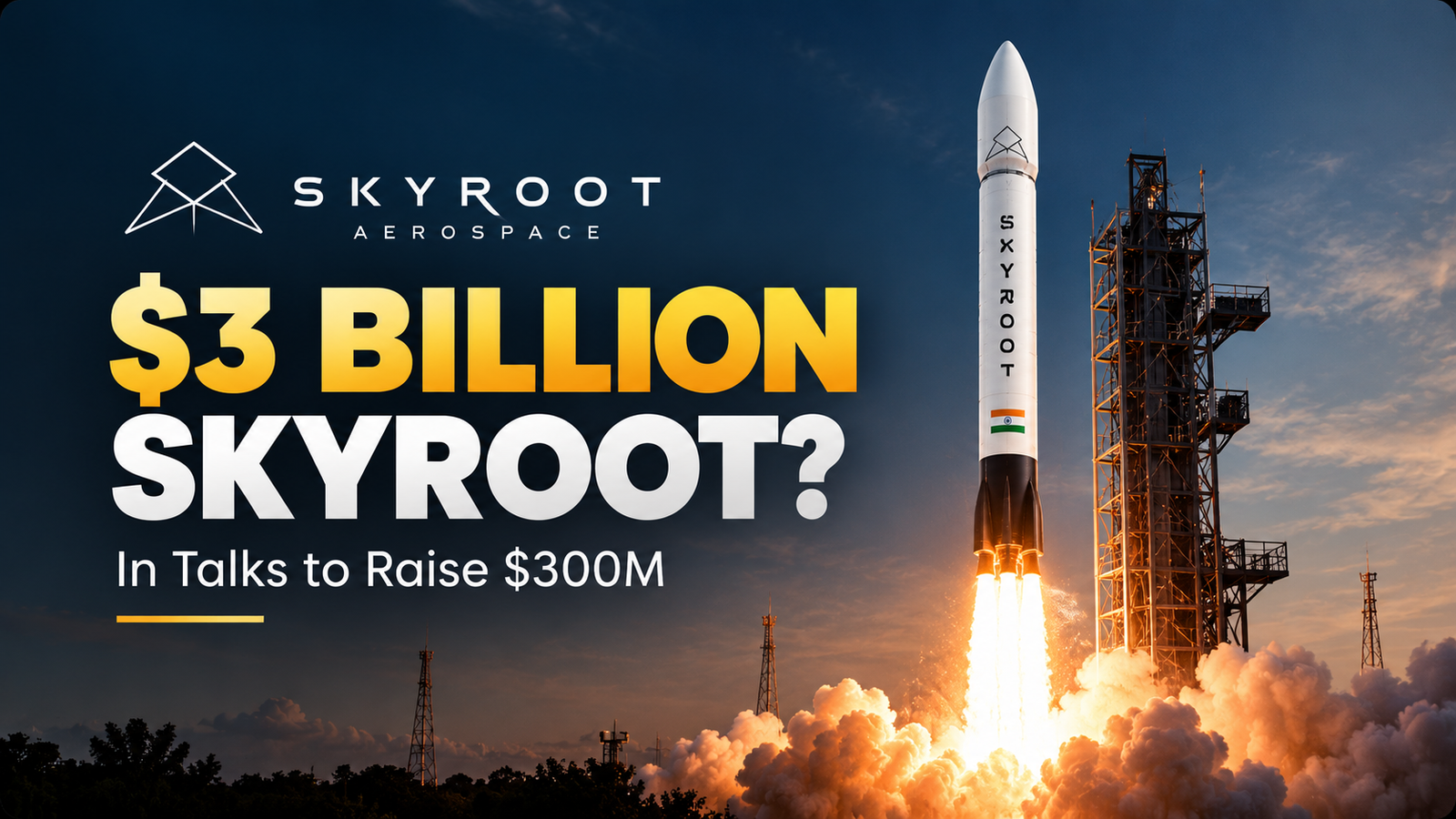
India’s private space industry is gaining serious attention from global investors. Hyderabad-based Skyroot Aerospace is reportedly in advanced talks to raise $280–300 million, a funding round that could value the company at around $2.8–3 billion.
What’s Happening?
According to a Moneycontrol report citing people familiar with the discussions, Skyroot is in talks with global investors including Fidelity, General Catalyst and Benchmark.
The proposed round could bring in roughly ₹2,600–2,850 crore for the Indian space-tech startup. The final funding size, valuation and investor participation could still change as negotiations continue.
Fidelity could reportedly invest around $170–190 million, while General Catalyst may contribute $70–80 million. Benchmark is reportedly considering an investment of around $20–30 million.
Why Is This Significant?
The potential deal comes only months after Skyroot became India’s first space-tech unicorn.
In May 2026, Skyroot raised about $60 million at a pre-money valuation of roughly $1.1 billion. The round was co-led by Sherpalo Ventures and GIC, with participation from investors including BlackRock, Arkam Ventures and Playbook Partners.
If the latest deal closes at the reported valuation, Skyroot’s valuation would have increased dramatically within just a few months.
That kind of jump shows how investor interest in India’s private space sector is changing.
The Vikram-1 Effect
One of the biggest reasons behind the renewed investor interest is likely Skyroot’s progress with its Vikram rocket program.
On July 18, 2026, Skyroot successfully launched Vikram-1 from the Satish Dhawan Space Centre in Sriharikota. It became the first privately developed Indian orbital launch vehicle to successfully reach orbit from Indian soil.
The mission carried multiple payloads, including the SCOPE and Grahaa satellites, into low Earth orbit.
The successful mission was an important validation of Skyroot’s technology and its ambition to provide commercial launch services.
What Does Skyroot Build?
Skyroot develops the Vikram family of launch vehicles, designed primarily to provide flexible access to space for small satellites.
Its Vikram-I can carry up to around 350 kg to low Earth orbit, according to the company. The rocket uses an all-carbon-composite structure along with solid-fuel boosters and a 3D-printed liquid-fuel engine.
The company is also developing Vikram-II, a larger vehicle designed to carry up to 900 kg to low Earth orbit. Skyroot currently lists Vikram-II for launch in 2027.
Benchmark’s India Entry
The proposed deal could also be significant for another reason.
If completed, Benchmark would reportedly make its first investment in India through Skyroot. The Silicon Valley venture capital firm is known for early investments in companies such as Uber, Twitter and Snap.
A Benchmark investment would therefore be another signal that global venture capital firms are becoming more interested in India’s deep-tech and space ecosystem.
India’s Private Space Race Is Growing
Skyroot is not alone. Indian space-tech startups are increasingly attracting private capital across launch vehicles, satellites, propulsion, Earth observation and other technologies.
According to Business Standard, Indian spacetech startups had raised about $871 million across 241 funding rounds involving 285 companies by July 2026. Skyroot was the sector’s most-funded startup at that point.
Government reforms introduced in 2020 helped open the space sector to private companies, creating opportunities for startups to build rockets, satellites and other space infrastructure.
What Happens Next?
The immediate focus is on whether Skyroot closes the reported $280–300 million funding round.
If completed, the capital could give the company significantly more resources to scale its launch business and develop its next-generation vehicles.
For India, the bigger story is that private space companies are moving beyond experimental missions and toward commercial launch operations.
Skyroot has already demonstrated that an Indian startup can build and launch an orbital rocket. The next challenge is turning that achievement into a repeatable business.
Bottom Line
Skyroot Aerospace could be heading toward a valuation of nearly $3 billion just months after becoming India’s first space-tech unicorn.
The reported $280–300 million funding round has not been finalized yet, but if it closes, it would be another major milestone for both Skyroot and India’s rapidly expanding private space industry.
India’s space startup story is no longer just about reaching orbit. It is increasingly about building a commercial space business around it.