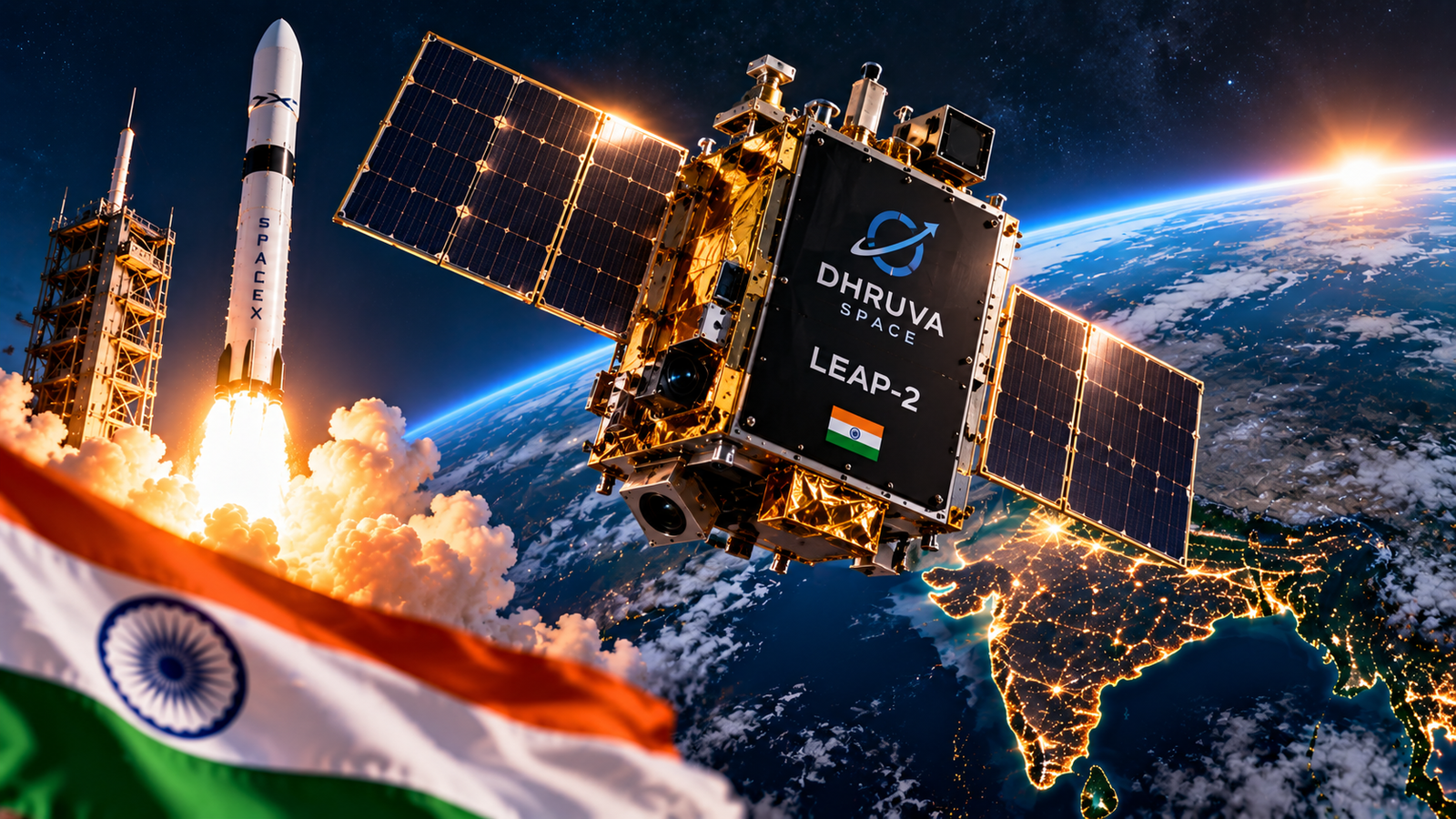
Indian space-tech company Dhruva Space has successfully deployed its LEAP-2 satellite into orbit aboard SpaceX’s Falcon 9, marking another major step for India’s growing private space industry.
Dhruva Space’s LEAP-2 mission launched as part of SpaceX’s Transporter-18 rideshare mission from Vandenberg Space Force Base in California.
The Falcon 9 lifted off at 12:02 AM IST on October 2, carrying around 130 payloads from companies and organisations around the world. Dhruva Space’s LEAP-2 was among the Indian payloads that reached orbit.
What is LEAP-2?
LEAP stands for Launching Expeditions for Aspiring Payloads.
Instead of forcing a company to build an entire satellite just to test one piece of technology, Dhruva Space’s LEAP programme provides a satellite platform where multiple payloads can be hosted and tested in orbit.
LEAP-2 uses Dhruva Space’s P-30 satellite platform and carries multiple in-orbit demonstration technologies
- PHP2Shell: Two Critical PHP Vulnerabilities Discovered — Update Your Server Now
- Elevenlabs alternative: OmniVoice-This Open-Source AI Tool Can Clone Your Voice in Seconds
- This Developer Built an Open-Source Razorpay Alternative With Zero Gateway Fees — Meet YouPI-PG
- iOS 18 Jailbreak in 2026: Latest Status, Compatible Tools and What iPhone Users Should Know
- 10 Claude Prompt Tricks Every Student Should Know in 2026
What’s riding on LEAP-2?
One of the key payloads is TAPAS-1, developed by Indian space-tech startup SatLeo Labs.
TAPAS-1 uses thermal infrared sensing to detect temperature patterns on Earth’s surface. Unlike conventional optical cameras, thermal sensors can provide information about heat that isn’t directly visible in normal imagery.
Potential applications include:
🌾 Crop-stress monitoring
🔥 Forest-fire detection
🌆 Urban heat mapping
🌍 Climate and environmental monitoring
🚨 Disaster-related applications
Dhruva Space says TAPAS-1 is intended to validate its sensing, calibration and processing capabilities in orbit.
Dhruva Space Is Doing More Than Building Satellites
An interesting part of LEAP-2 is that Dhruva Space also handled the end-to-end launch integration of the satellite with SpaceX’s Falcon 9. The company says this builds on its LEAP-1 experience, where it became the first Indian private company to undertake launch-vehicle integration of its satellite in-house. Dhruva is also developing ground infrastructure to support missions after launch, including a company-owned ground station in Luleå, Sweden.
🇮🇳 Why This Matters for India’s Space Industry
The significance of LEAP-2 isn’t just that another Indian satellite has reached orbit.
It demonstrates a business model where startups can test their space technologies without having to develop an entire spacecraft and launch system themselves.
Dhruva Space provides the satellite platform, payload integration, launch coordination and ground-segment support, allowing customers to focus on their own technology. At the same time, Indian companies such as SatLeo Labs are getting an opportunity to test commercial space technologies in orbit. With private companies increasingly participating in satellite manufacturing, Earth observation and space infrastructure, missions like LEAP-2 show how India’s space ecosystem is expanding beyond traditional government-led programmes.