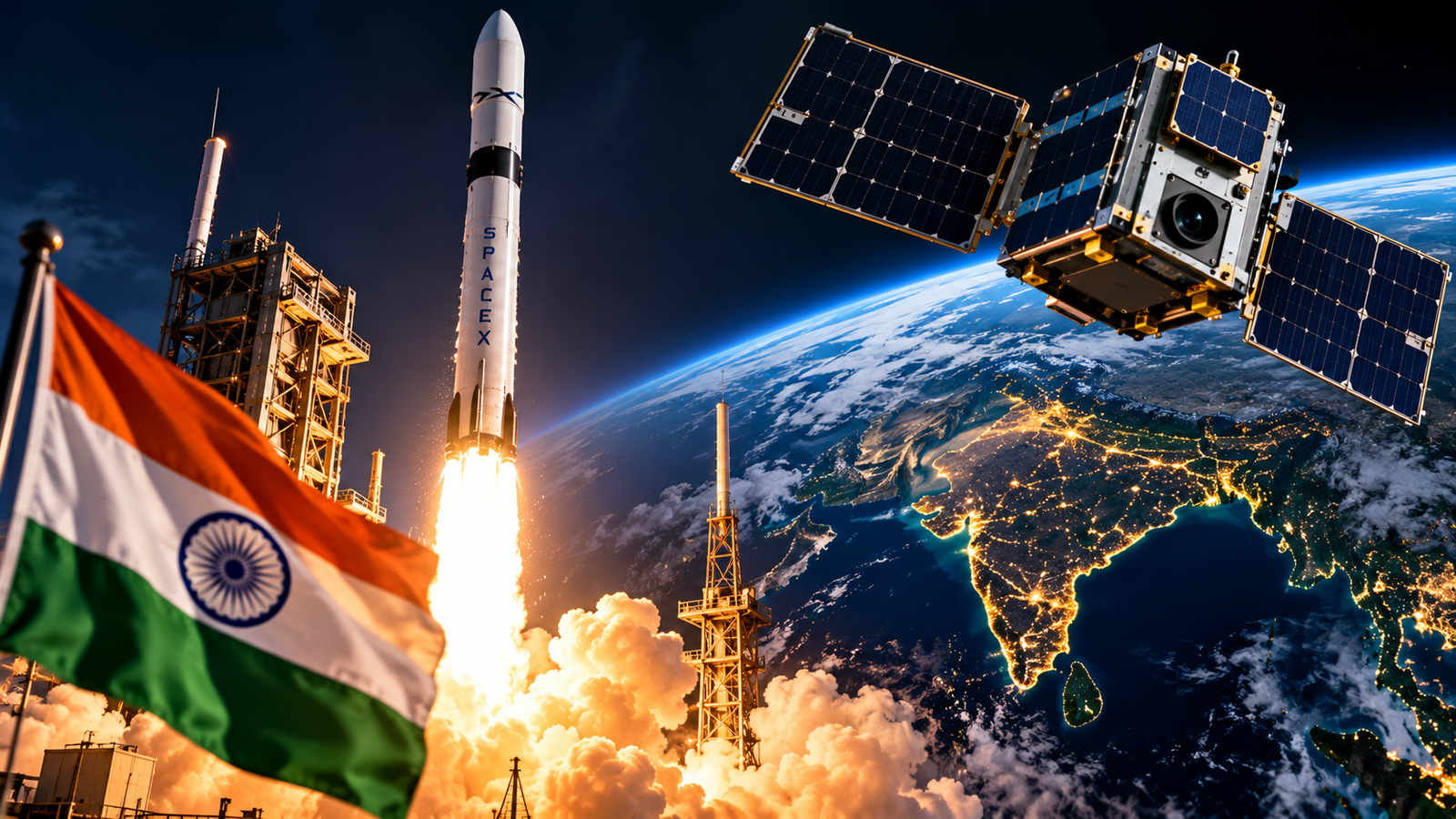
India’s private space sector just hit another milestone. Four Indian space-tech companies have sent their technologies into orbit aboard SpaceX’s Falcon 9 as part of the Transporter-18 rideshare mission.
The Falcon 9 launched from Vandenberg Space Force Base in California on October 1 local time, carrying around 130 payloads. Among them were technologies developed by Indian startups including Dhruva Space, TakeMe2Space, SatLeo Labs and EON Space Labs.
AI Is Going Into Orbit
One of the most interesting payloads comes from Hyderabad-based TakeMe2Space.
Its MOI-1A spacecraft is designed to perform AI computing directly in orbit. Instead of sending huge amounts of raw satellite data back to Earth for processing, AI models can process the data onboard and send back the useful results.
The satellite carries an NVIDIA Jetson Orin NX-based computing system, around 2TB of storage, and a multispectral imaging system.
That could be useful for applications such as agriculture, mapping, mining and other Earth-observation tasks where transmitting large datasets back to Earth can be expensive.
Another Startup Is Giving Satellites a “Thermal Eye”
Ahmedabad-based SatLeo Labs is testing TAPAS-1, a thermal-imaging payload hosted on Dhruva Space’s LEAP-2 platform.
Unlike conventional optical cameras, thermal sensors can detect temperature patterns on Earth’s surface. That could eventually help with applications such as monitoring urban heat, crop stress, infrastructure and environmental changes.
Dhruva Space’s Role
Dhruva Space’s LEAP-2 is a commercial hosted-payload platform built on its P-30 satellite platform.
The idea is simple: companies can test their space technology by placing it on a shared spacecraft instead of having to develop and launch an entire satellite themselves.
Dhruva says LEAP-2 hosts multiple in-orbit demonstration payloads, including SatLeo’s TAPAS-1 and a star tracker developed by France-based Sodern.
EON Space Labs Joins the Mission
Hyderabad-based EON Space Labs also has technology aboard the mission.
Its MIRA miniaturised space-imaging system is flying with TakeMe2Space’s MOI-1A spacecraft and is intended as a pathfinder for future space-imaging capabilities.
🇮🇳 Why This Matters
This mission shows that India’s private space industry is moving beyond simply building satellites.
Indian startups are now working on AI computing in orbit, thermal imaging, Earth observation and commercial satellite infrastructure.
And the interesting part is that these technologies don’t necessarily need to wait for an Indian rocket. Through commercial rideshare missions such as SpaceX’s Transporter programme, startups can send their hardware into orbit alongside many other payloads.
The next phase of India’s space race may not just be about getting satellites into space — it could be about making those satellites smart enough to process information while they’re still there.