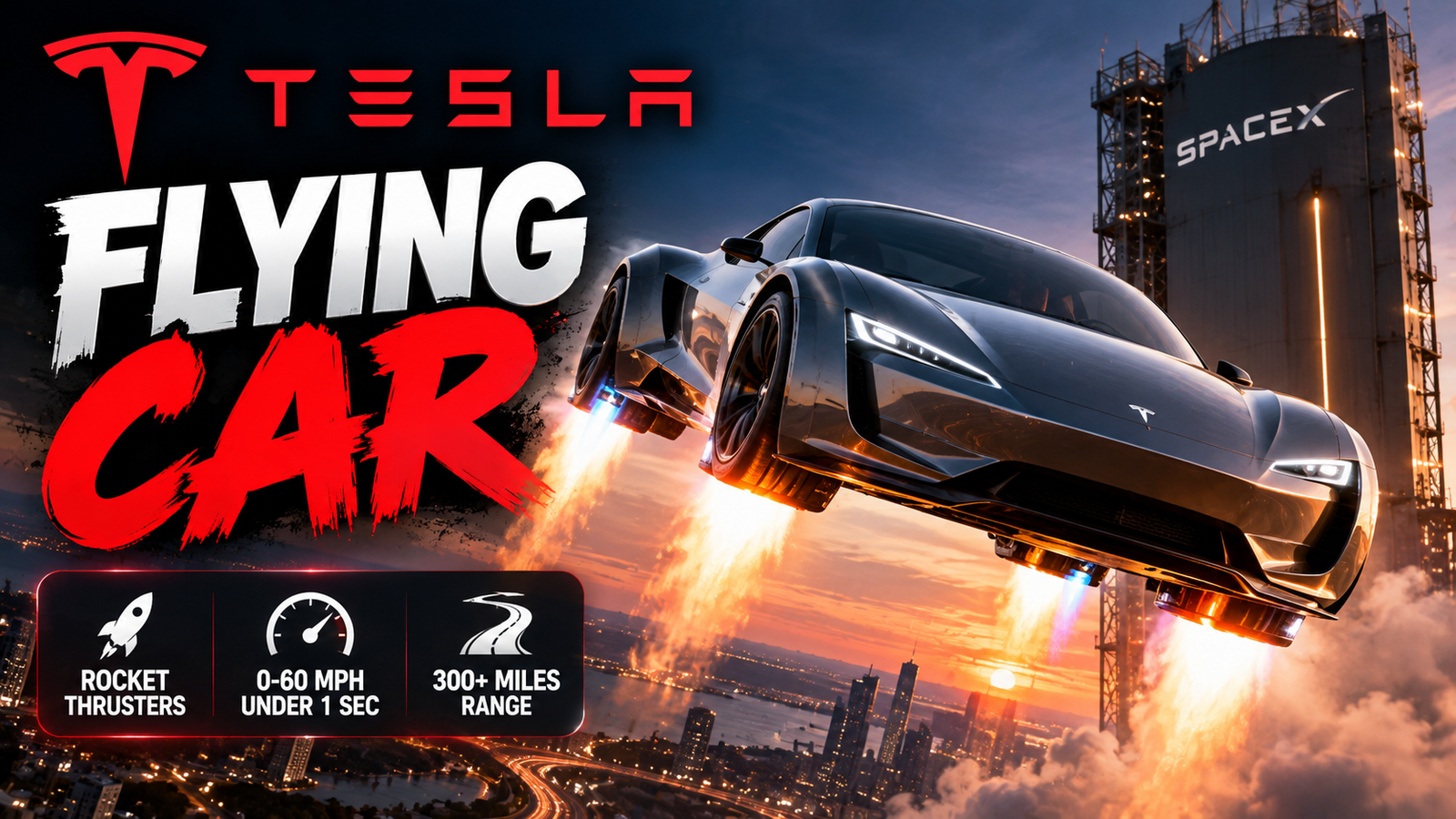
Elon Musk has unveiled a rocket-equipped Tesla Roadster that can briefly lift off, flip in mid-air and land using thrusters. But before you imagine flying to work in a Tesla, there are some important details: the vehicle is still under development, its flight-capable version is not approved for public roads, and production is targeted for 2028.
Published: October 16, 2026
Category: Tech News / Electric Vehicles
Tesla has taken its long-delayed Roadster project in an unexpected direction: the company has demonstrated an electric sports car capable of briefly flying using rocket-inspired technology developed with SpaceX.
Unveiled on October 15, 2026, at a SpaceX facility in Texas, the redesigned Tesla Roadster performed dramatic stunts, including turning in mid-air and landing back on its wheels. The demonstration also featured the car moving upside down along a ramp using a suction system before launching into the air.
The announcement has reignited interest in the future of flying cars. However, the new Roadster is not a conventional flying vehicle designed to travel through the sky like an aircraft. Its airborne capabilities rely on specialized thrusters, and the flight-capable Rocket version is still under development.
Tesla plans to begin production in 2028.
How Does Tesla’s Flying Roadster Work?
The most unusual feature of the new Roadster is its use of technology associated with SpaceX, Musk’s aerospace company.
Rather than relying on conventional wheels alone, the flight-capable configuration uses high-pressure gas thrusters to generate brief bursts of thrust. These help the vehicle perform the airborne maneuvers demonstrated at the launch event.
Tesla has also highlighted a multi-mode suction system and active aerodynamic components. The suction system can help hold the car against a specially designed surface, allowing it to travel upside down during a demonstration.
The different systems serve different purposes:
- Cold-gas thrusters: Provide short bursts of thrust for airborne maneuvers.
- Suction system: Helps the vehicle adhere to a surface in specialized conditions.
- Active aerodynamics: Adjusts airflow and downforce to improve vehicle performance.
- Electric powertrain: Continues to provide the Roadster’s conventional driving capability.
These technologies make the Roadster an unusual engineering project, but they do not automatically make it a practical flying car. Controlled demonstrations are very different from safely taking off, navigating and landing in everyday environments.
Tesla Roadster: Key Specifications and Features
Tesla’s unveiling included ambitious performance claims for the redesigned electric sports car.
| Feature | Reported details |
|---|---|
| Vehicle | Next-generation Tesla Roadster |
| Powertrain | All-electric |
| Special technology | SpaceX-developed rocket-style thrusters |
| Claimed acceleration | 0–60 mph in under 1 second |
| Claimed top speed | More than 230 mph |
| Reported range | More than 300 miles per charge |
| Production target | 2028 |
| Flight-capable version | Rocket variant, invite-only |
| Confirmed final retail price | Not announced |
These performance figures are claims reported at the unveiling, not independently verified production-car results. The specifications and features could change before the vehicle enters production.
The reported range is also substantially lower than the 620-mile range previously advertised for the earlier Roadster concept on Tesla’s US website. The final specifications will need to be confirmed when a production version becomes available.
Three Tesla Roadster Versions: Performance, Thrust and Rocket
Tesla’s reservation information describes three versions of the Roadster, with different capabilities.
1. Performance
The Performance version is intended to be the more conventional road-oriented electric sports car. It features the active aerodynamic and suction systems but does not include the full flight system.
Reuters reported that Tesla’s reservation page listed a $50,000 deposit for this version.
2. Thrust
The Thrust version adds acceleration thrusters intended to enhance performance. It is positioned as a more specialized, high-performance configuration.
Its reported reservation deposit is $250,000, although the final purchase price and exact production specifications have not been finalized.
3. Rocket
The Rocket is the most unusual version. Tesla describes it as a single-seat configuration with a full flight system, and access is currently listed as invite-only.
Importantly, Tesla’s reservation information says the Rocket version is not approved for public road use. Its flight capabilities should therefore not be confused with an ordinary road-legal vehicle.
The deposits are not the final purchase prices, and Tesla’s terms state that the company cannot guarantee when the vehicle will be delivered—or whether it will ultimately be delivered. Buyers should review the official Roadster reservation information before making any commitment.
Is Tesla’s Flying Car Available to Buy?
Not as a production-ready flying vehicle.
Tesla has demonstrated the technology and opened reservations for different Roadster configurations, but the car remains under development. Elon Musk has said production is expected to begin in 2028.
That timeline is significant because the next-generation Roadster was originally unveiled in 2017, with deliveries initially expected much earlier. The project has experienced years of delays.
There is also a major distinction between reserving a vehicle and receiving a finished product. The reservation terms leave the final specifications, pricing and delivery timing subject to change.
For now, the public has seen a demonstration of what the vehicle can do under controlled conditions—not proof that customers will soon be able to use a flying Tesla on public roads.
Can You Drive or Fly It on Public Roads?
This is one of the biggest unanswered questions surrounding the new Roadster.
The flight-capable Rocket configuration is explicitly described as not approved for public road use. Business Insider also reported that Elon Musk acknowledged uncertainty about whether the thruster-equipped versions would be legal in every jurisdiction.
The US Federal Aviation Administration has reportedly told Business Insider that the Tesla vehicle does not meet its definition of an aircraft. That distinction does not automatically make the car’s airborne operation legal on public roads or in other regulated environments.
Any commercial version would need to comply with applicable vehicle safety rules and other relevant regulations. The legal requirements for its specialized airborne functions could be different from those governing its normal driving mode.
Until Tesla provides clearer details and the relevant authorities establish what is permitted, it is too early to describe the Rocket Roadster as a flying car that customers can freely use on public roads.
Why Is Tesla Combining Cars and Rocket Technology?
The Roadster is more than a performance-car announcement. It is also a showcase for the engineering capabilities of Tesla and SpaceX.
Tesla specializes in electric vehicles, batteries, power electronics and vehicle systems. SpaceX develops rocket propulsion and aerospace technologies. The Roadster demonstration brings elements of those engineering worlds together in a highly visible product.
However, the commercial value of the project remains uncertain.
Reuters reported that analysts view the Roadster partly as a “halo car”—a high-profile vehicle intended to demonstrate a company’s technical ambition and strengthen its brand. The Roadster may generate attention even if it is produced in relatively limited numbers.
The announcement has also revived speculation about a closer relationship between Tesla and SpaceX. But speculation about a potential merger is not the same as a confirmed corporate transaction.
Is This the Beginning of Flying Cars?
Not necessarily.
Several companies are developing electric vertical take-off and landing aircraft, often called eVTOLs. These vehicles are designed specifically to transport people through the air and require a different approach to propulsion, stability, safety and certification.
Tesla’s Roadster takes another route: it remains an electric sports car with specialized hardware that enables brief airborne maneuvers.
That is an impressive demonstration, but it does not solve all the challenges associated with practical flying cars, including safe passenger transport, reliable navigation, emergency procedures, noise, energy requirements and airspace regulation.
The technology is worth watching, but the gap between a dramatic prototype demonstration and a commercially useful flying vehicle remains substantial.
Sources
- Reuters — Tesla’s new Roadster turns in air with SpaceX thrusters, won’t land until 2028
- CBS News — With Tesla Roadster debut, Elon Musk shows “flying cars are real”
- Business Insider — What buyers should know about the new flying Roadster
- Tesla — Official Roadster website and reservation information
This article is based on reporting published on October 15–16, 2026. Specifications, pricing, delivery dates and legal status may change as Tesla continues development.