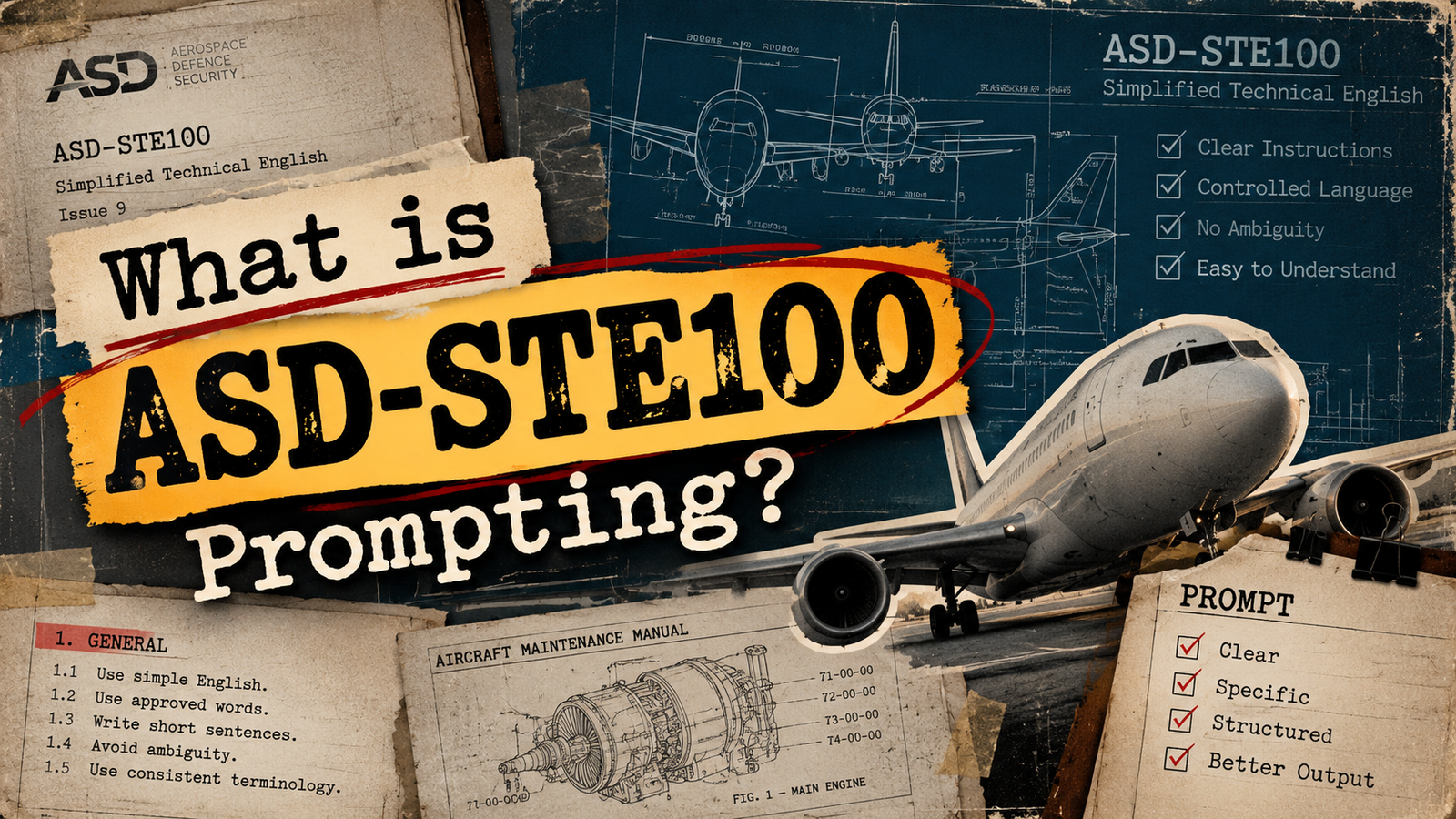
ASD-STE100 is a standard for writing clear and controlled technical English. While it was originally developed for aerospace documentation, its principles can also be useful when writing AI prompts that need to be precise, consistent, and easy for an AI system to understand.
What Is ASD-STE100?
ASD-STE100 stands for ASD Simplified Technical English. It is an international standard designed to make technical documentation easier to understand, especially when the information is complex or safety-critical.
The standard provides two main things: a set of writing rules and a controlled dictionary of approved words and meanings. The goal is simple: reduce ambiguity and make technical instructions easier to read and interpret.
ASD-STE100 was originally created for the aerospace industry, particularly for aircraft maintenance documentation. Today, its principles are also used in other technical industries.
So, What Is ASD-STE100 Prompting?
“ASD-STE100 prompting” is not an official ChatGPT prompting feature or a separate OpenAI prompt framework. Instead, the term can be used to describe applying Simplified Technical English principles when writing prompts for AI.
The idea is straightforward: instead of giving an AI a long, vague, or complicated instruction, write the prompt using short sentences, specific words, clear instructions, and a well-defined output format.
For example, instead of saying:
“Can you go through this document and basically tell me what it is about, what the important things are, and if there are any problems that someone should know about?”
You could write:
“Analyze this document. Identify its main purpose. List the key points. Identify potential problems. Explain each problem in simple English.”
The second prompt is easier to interpret because every instruction has a clear purpose.
Why Does ASD-STE100-Style Prompting Matter?
AI models can usually understand natural language even when prompts are informal. However, unclear instructions can still produce inconsistent or unwanted results.
A more controlled writing style can help when you are working with technical documents, coding, engineering instructions, research papers, business processes, or other tasks where precision matters.
The main benefit is not making the AI “smarter.” It is reducing ambiguity in the instructions you give it.
The Main Principles
1. Use Short Sentences
Avoid putting several instructions into one long sentence. Break the task into smaller instructions.
Instead of:
“Analyze the report and explain the main findings while also checking whether there are errors and suggesting improvements.”
Use:
“Analyze the report. Identify the main findings. Check for errors. Suggest improvements.
2. Use Specific Words
Avoid vague words such as “things,” “good,” “better,” or “some information” when you can describe exactly what you want.
Instead of:
“Give me some information about the product.”
Use:
“List the product’s main features, price, release date, and target users.”
3. Avoid Unnecessary Synonyms
In technical writing, using different words for the same thing can create confusion. Use the same term consistently.
For example, if you call something a “customer” at the beginning of a prompt, do not randomly switch between “customer,” “client,” “buyer,” and “user” unless they have different meanings.
4. Give One Instruction at a Time
Separate different tasks instead of combining everything into one sentence.
A structured prompt could look like this:
“1. Summarize the document.
2. Identify the main problems.
3. Explain the causes.
4. Suggest solutions.”
This makes the expected workflow much clearer.
ASD-STE100 Prompting vs Normal Prompting
Normal prompting can be conversational and flexible. For example:
“Hey, can you look at this document and tell me what is important?”
An ASD-STE100-style prompt would be more structured:
“Analyze the document. Identify the three most important points. Explain each point in simple English. Use bullet points.”
Both prompts can work, but the second one leaves less room for interpretation
Who Can Use It?
This approach can be especially useful for engineers, programmers, technical writers, researchers, students, documentation teams, and anyone who regularly works with complex information.
It can also be useful when creating prompts for tasks where accuracy and consistency are more important than conversational style.
Bottom Line
ASD-STE100 was created to make technical English clear, controlled, and easier to understand. Its principles can also be applied to AI prompts.
The basic idea is simple: use short sentences, specific words, consistent terminology, clear instructions, and a defined output format.
You do not need to write every ChatGPT prompt like an aircraft maintenance manual. But when a task requires precision, using a more controlled writing style can make your prompts much clearer—and potentially produce more consistent results.
Very nice and fantastic
Amazing work! 👏 The website looks clean, creative, and really well-designed. Keep up the great work! 💻✨